


Grouting small conduit

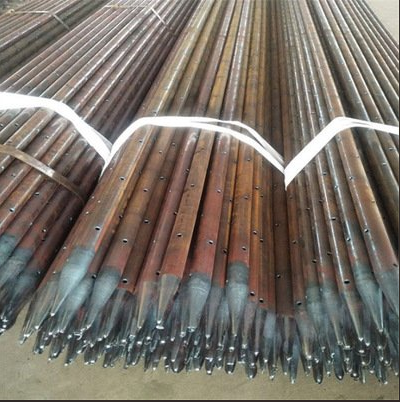
Definition and structural characteristics
The grouting pipe is a tubular component used for geotechnical engineering reinforcement and water stopping. It is usually made of steel pipe with a small diameter, generally between 32-76mm. Its length depends on the specific engineering requirements, and the common length is 3-6m. The front end of the pipe is usually processed into a pointed cone to facilitate insertion into the rock and soil. There are also grouting holes on the pipe wall. The diameter of the grouting holes is generally around 6-10mm, and the spacing is 10-20cm. These grouting holes can evenly inject the slurry into the pores and cracks of the rock and soil.
How it works
Reinforcement principle: In geotechnical engineering, after a small grouting tube is inserted into the rock and soil mass that needs to be reinforced, cement slurry or other chemical slurry is injected into the tube through the grouting equipment. Under the action of pressure, the slurry enters the pores and cracks of the rock and soil mass through the grouting holes on the tube wall. As the slurry solidifies, it fills these gaps and bonds the loose rock and soil particles together, thereby improving the strength and integrity of the rock and soil mass. For example, during the tunnel excavation process, grouting reinforcement of the surrounding rock around the tunnel can effectively prevent the surrounding rock from loosening and collapsing.
Water-stopping principle:When encountering a stratum rich in groundwater, the grouting pipe can be used as part of the water-stop curtain. The injected slurry forms a water barrier in the rock and soil to prevent the flow of groundwater. For example, in a deep foundation pit project, by setting up a grouting pipe around the foundation pit and injecting grout, it can effectively prevent groundwater from infiltrating into the foundation pit and ensure the safety of the foundation pit construction.
advantage
Flexible construction:The small grouting pipe is small in size and light in weight, which is convenient for construction in narrow spaces and complex terrain conditions. The insertion angle and depth can be adjusted according to the actual situation of the project, and it is suitable for various geotechnical engineering environments, such as tunnels, slopes, foundation pits, etc.
Lower cost:Compared with some large-scale reinforcement and water-stopping measures, the material cost and construction cost of grouting small pipes are relatively low. It can effectively solve the problems of rock and soil reinforcement and water-stopping without taking up too much engineering budget.
The effect is remarkable:Can quickly reinforce and stop water in rock and soil. In a short time, grouting can significantly improve the mechanical properties of rock and soil, and effectively control the seepage of groundwater, thereby improving the safety and stability of the project.
Application Areas
Tunnel Engineering:In tunnel construction, small grouting pipes are often used for advance support. A small grouting pipe is driven into the rock mass in front of the tunnel face, and grout is injected in advance to reinforce the surrounding rock and prevent the surrounding rock from collapsing during the excavation process. It can also be used to deal with local water gushing problems in tunnel construction, and grouting is used to stop water and ensure the smooth progress of tunnel construction.
Slope Engineering:For the reinforcement and waterproofing of soil slopes and rock slopes, grouting small pipes are a common method. They can be driven into the rock and soil along the slope surface or oblique direction to reinforce the soil or rock of the slope, while preventing the scouring and erosion of the slope by rainwater or groundwater, and improving the stability of the slope.
Foundation pit engineering:In deep foundation pit support, the grouting small pipe can be used as a component of the water-stop curtain and used in conjunction with other support structures (such as cast-in-place piles, underground continuous walls, etc.). By grouting in the stratum around the foundation pit, a water-blocking layer is formed to prevent groundwater from flowing into the foundation pit, ensuring a dry environment for the foundation pit and facilitating construction in the foundation pit.
Construction technology
drilling:First, according to the design requirements, use a drill to drill a hole in the rock mass that meets the requirements for inserting the small catheter. The diameter of the hole should be slightly larger than the outer diameter of the small catheter, generally 2-4mm larger than the outer diameter of the small catheter. The depth and angle of the hole should be strictly controlled according to the design requirements to ensure that the small catheter can be accurately inserted into the predetermined position.
Small catheter fabrication and insertion: Process the steel pipe into a small conduit with a pointed conical head and a grouting hole. Before inserting the small conduit, clean the surface of the small conduit to ensure that there is no impurities such as oil and rust. Then insert the small conduit into the drilled hole. During the insertion process, be careful to avoid damaging the grouting hole of the small conduit. The insertion depth must meet the design requirements, and the position of the small conduit must be accurate.
Grouting:After the small catheter is inserted, connect the grouting equipment. Configure appropriate grouting materials, generally cement-water glass double liquid slurry or ordinary cement mortar, etc. Grouting is carried out according to the designed grouting pressure and grouting volume. During the grouting process, observe the grouting condition of the orifice. When slurry flows out of the orifice and the slurry concentration is close to the injected slurry concentration, it means that the grouting is basically full. After the grouting is completed, the grouting equipment should be cleaned in time to prevent the slurry from solidifying and clogging the equipment.
Quality control points
Material quality:Strictly control the quality of the steel pipe of the small conduit, including the material, diameter, wall thickness, etc. The steel pipe should have sufficient strength and toughness to withstand the external force and grouting pressure during the insertion process. The quality of the grouting material must also be strictly controlled to ensure that its performance meets the design requirements, such as the fluidity, setting time, strength, etc. of the slurry.
Drilling quality:The deviation of the depth, diameter and angle of the borehole should be controlled within the allowable range. If the borehole depth is not enough, the small catheter cannot achieve the expected reinforcement and water-stopping effect after insertion; if the borehole diameter is too large, the small catheter may become loose after insertion, affecting the grouting effect; if the borehole angle deviation is too large, the small catheter cannot be accurately inserted into the predetermined rock and soil area.
Grouting quality:Grouting pressure and grouting volume are the key to grouting quality control. Too high grouting pressure may cause the rock and soil to split and destroy the original structure of the rock and soil; too low grouting pressure will not allow the slurry to fully fill the pores and cracks of the rock and soil. Insufficient grouting volume will lead to unclear reinforcement and water-stopping effects, so the grouting pressure and grouting volume must be strictly controlled according to the design requirements. At the same time, the continuity of the grouting process must be ensured to avoid grouting interruptions.
Classification of grouting small tubes
Classification by material
Steel pipe grouting small conduit:This is the most common type, generally made of ordinary carbon steel or low alloy steel pipe. The steel pipe has high strength and toughness, and can withstand large insertion force and grouting pressure. For example, in tunnel advance support, it is necessary to insert a small conduit into the harder surrounding rock, and the steel pipe grouting small conduit can meet this requirement well. At the same time, the steel pipe has strong machinability, and grouting holes can be easily drilled on the pipe wall, and it can be well connected with the grouting equipment to ensure the smooth progress of the grouting process.
Plastic pipe grouting small catheter:Made of plastics such as polyvinyl chloride (PVC) and polyethylene (PE). The advantage of plastic pipes is that they are corrosion-resistant. They are used in some formation environments that are corrosive to metals (such as areas with acidic groundwater) to prevent small pipes from being corroded and affecting the grouting effect and service life. In addition, plastic pipes are relatively light and easy to carry and construct. However, their strength is lower than that of steel pipes, and they are usually suitable for projects that do not require high strength for small pipes, such as shallow soil slope reinforcement projects.
Classification by pipe diameter
Small diameter grouting tube:The diameter of the pipe is generally between 32 and 42mm. This small pipe is suitable for situations where the pores of the rock and soil are small and the grouting volume is relatively small. For example, in some sandy soil layers with finer particles, a small diameter grouting pipe can effectively inject slurry into the pores of the soil layer to reinforce and stop the soil layer.
Large diameter grouting small pipe: The diameter of the pipe is between 48 and 76 mm. Large diameter small pipes can pass a larger amount of grouting, and are suitable for situations where a large amount of grouting is required, such as in rock formations with well-developed fractures, or for projects that require rapid filling of large gaps, such as filling and reinforcing the cavity after a local collapse of a tunnel.
Classification by grouting hole distribution
Evenly distribute the grouting holes with small conduits:The grouting holes are evenly distributed in the axial and circumferential directions on the wall of the small conduit. This distribution method can make the slurry spread evenly in the rock and soil, ensuring the uniformity of the reinforcement and water-stopping effect. For example, in the construction of a water-stop curtain with high requirements, the small conduit with evenly distributed grouting holes can make the slurry form a relatively uniform water-proof layer underground, effectively preventing the seepage of groundwater.
Small pipes for non-uniformly distributed grouting holes:The distribution of grouting holes is not uniform, and may be designed according to the specific conditions of the rock and soil (such as areas with more local cracks and higher porosity). For example, in the rock formation, if it is known that the cracks in certain areas are more concentrated, more grouting holes can be set at the corresponding positions of the small pipes, so that more slurry can be injected into these crack-concentrated areas, improving the pertinence and effect of grouting.
Classification by purpose
Reinforced grouting small pipe。
Water-stop grouting small pipe
Composite grouting small tube。
The following are some common grouting small pipe size specifications:
| Diameter (mm) | Wall thickness (mm) | Length (m) |
| 25 | 2.0-3.5 | Uncertain 1 |
| 32 | 2.0-3.5 | Uncertain 1 |
| 42 | 2.0-3.5 | Uncertain 12 |
| 48 | 2.0-3.5 | Uncertain 12 |
| 50 | 2.0-3.5 | Uncertain 12 |
| 60 | 2.0-3.5 | Uncertain 1 |
| 76 | / | Uncertain 3 |
| 89 | / | Uncertain 34 |
| 108 | / | Uncertain 34 |


1.Q: I have never done business with you before, how can I trust your company?
Answer: Our company has entered Alibaba.com11years, longer than most other suppliers, we have been a gold supplier for many years. What's more, we have a large number of authorization certificates, such asBVISO9001,API, Alibaba on-site inspection certificate. I hope the above content can convince you.
2.Q: What is the minimum order quantity?
A: Yes, our company mainly deals in wholesale transactions, but if you insist on buying one piece, or you only need one piece, we will most likely mass produce it for you with a minimum order quantity.
3.Q: How can I get a sample to check your quality? How long can I get the sample?
A: After the price is confirmed, free samples can be provided for your evaluation. After you confirm the sample details, the sample will be3-7 days to be ready for delivery and will be sent to you by courier and3-5Arrived within days.
4.Q: What payment methods do you accept?
A: We accept T/T, L/C, Western Union.
5.Q: What are your company's shipping terms and delivery time?
Answer: Bulk20-30Days, Inventory5-10working days
6.Q: Do you have any discounts?
A: We will definitely try our best to help you get these with the best price and good service.